
Short version, because this gets muddled everywhere.
Anti-glare is a coating. It stops light reflecting off the surfaces of your lens. More light reaches your eye, reflections stop showing up in photographs, and headlights stop starring at night. You can see the benefit by holding a coated lens next to an uncoated one.
Blue cut is a filter. It reduces a narrow band of blue light, roughly 415 to 455 nanometres, which is the part of the spectrum screens put out most of. It is sold mainly as a fix for tired eyes. That specific claim is the one the evidence does not support.
They are different things. You can have either, or both. Most lenses sold as blue cut in India already include anti-glare, and that is a large part of why the two get confused.
What anti-glare does
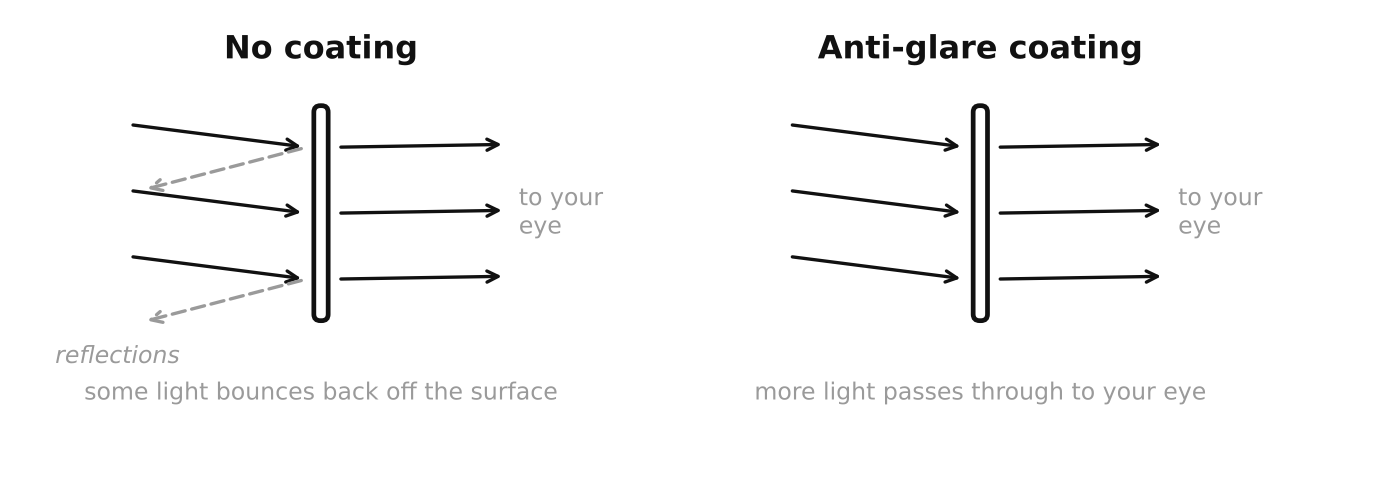
A lens without a coating reflects a few percent of the light hitting it, off each surface. That light has to go somewhere. Some of it bounces around inside the lens and comes back at your eye as a faint haze.
Take it away and three things change. Night driving gets easier, because headlights stop producing a starburst. Your eyes become visible in photographs and on video calls, instead of hidden behind two white rectangles. And in a room with overhead lighting, the sense of looking through something goes away.
This part is not controversial. There is no real argument against anti-glare beyond the cost. It is the coating to pay for first.
What blue cut does
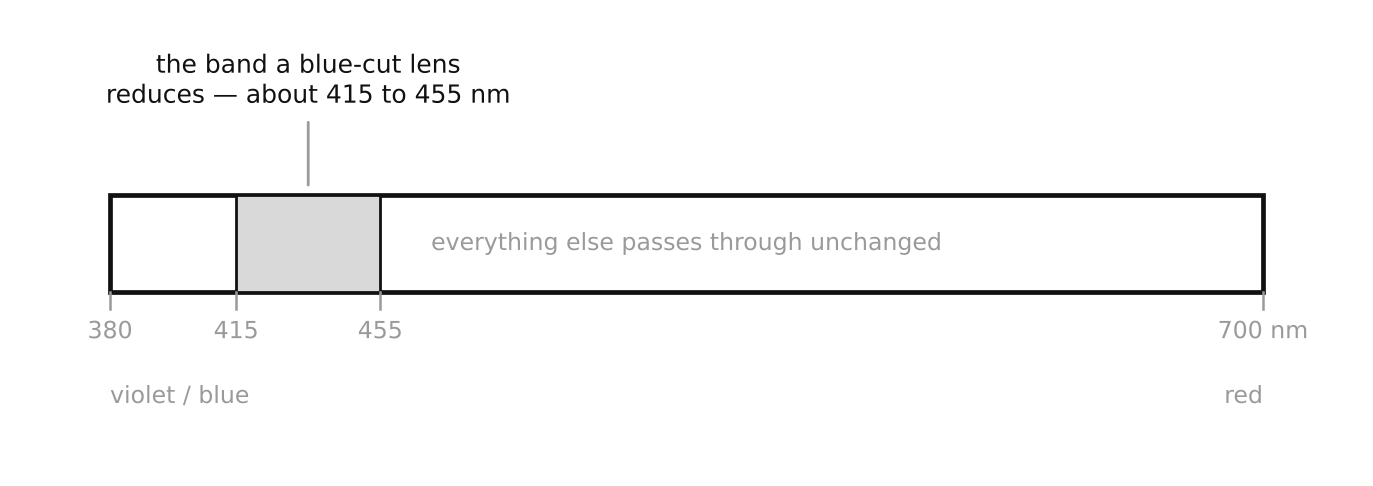
A blue-cut lens reduces how much short-wavelength light gets through. How much it reduces varies a lot by product. Some take out a few percent across the band. Some take out considerably more.
That part is real and measurable. What the reduction does for you is where it gets complicated.
The eye strain claim
This is what blue cut is actually sold on. It is also the claim with the least behind it.
A 2023 Cochrane review pooled the trials comparing blue-light filtering lenses against ordinary ones. It found they may not reduce the symptoms of eye strain from computer use. Effects on sleep quality came out inconclusive. On protecting the retina the review could reach no finding at all, because none of the studies had looked at it.
Cochrane reviews pool every decent trial on a question rather than running a new one. So this is about as settled as these things get. You can read it at cochrane.org under review CD013244. Read the Cochrane review.
So is it worthless?
No, and this is the part that gets lost in the backlash.
Most blue-cut lenses sold here come with anti-glare included. People who buy them usually do notice a difference. It is simply not coming from the part they paid extra for.
Some people also prefer the slightly warmer image. If you have tried both and you like looking through a blue-cut lens better, that is a perfectly good reason to buy one. It is just not a medical one.
Side by side
Swipe the table sideways to see every column.
| Feature | Anti-glare | Blue cut |
|---|---|---|
| What it does | Stops light reflecting off the lens surfaces | Reduces a band of blue light, about 415 to 455 nm |
| Night driving | Clear improvement | No meaningful effect |
| Eye strain from screens | Helps indirectly, by removing reflections | Not supported by the pooled evidence |
| Photographs and video calls | Eyes visible instead of white glare | No effect |
| Sleep | No claim made | Evidence inconclusive |
| Protecting the retina | No claim made | Not established either way |
| Worth paying for | Yes, on every pair | Only if you prefer how it looks |
If you are choosing between them and the budget only stretches to one, take the anti-glare.
What actually helps tired eyes
This is the reason most people end up on a page like this. So it is worth answering properly instead of selling a coating.
- Check the prescription. This is by a distance the most common cause of tired eyes at a screen. Either the prescription is slightly out, or there is a small astigmatism nobody has mentioned to you.
- Check the screen distance. A monitor sits about an arm away. That is neither reading distance nor distance vision. If you are over forty and squinting at a screen, that gap is the problem, and a lens made for it is the fix.
- Blink. People blink about half as often at a screen, which dries the surface of the eye. That dryness is what most people mean when they say their eyes are tired.
- Look away regularly. Twenty seconds at something across the room, every twenty minutes or so, lets the focusing muscle let go.
- Turn the brightness down to match the room. A screen much brighter than its surroundings is harder work than one that matches.
None of these cost anything. Together they do more than any coating will.
Where to get the test done
Everything above points at the same place. If your eyes are tired at a screen, the thing worth paying for is a proper examination, not a coating.
Ben Franklin has optical centres inside partner eye hospitals across India. An optometrist does the test in the same building as the eye doctors, using hospital equipment.
That matters for the things a quick chart reading misses. Tired eyes sometimes turn out to be dry eye. Sometimes it is an uncorrected astigmatism. Sometimes it needs a specialist rather than a lens.
If it does turn out to need a specialist, they are upstairs.

Frequently Asked Questions
What is the difference between anti-glare and blue cut?
Anti-glare is a coating that stops light reflecting off the lens surfaces, so more light reaches your eye. Blue cut is a filter that reduces a band of blue light around 415 to 455 nanometres. They do different jobs and are often sold together.
Is blue cut lens worth it?
For reducing eye strain, the pooled evidence does not support it. The 2023 Cochrane review found blue-light filtering lenses may not reduce symptoms of eye strain from computer use. If you prefer the warmer image they give, that is a reasonable reason to buy one.
Which is better, anti-glare or blue cut?
Anti-glare, if you are choosing one. The benefit is immediate and visible, particularly for night driving and on video calls.
Do blue cut lenses protect your eyes from screens?
There is no established evidence that they protect the retina. The Cochrane review could not assess it, because none of the trials had studied it. Screens do not put out enough short-wavelength light to be considered a hazard to the retina.
What actually helps eye strain from computers?
A correct prescription first. Then blinking more, looking away from the screen regularly, and matching screen brightness to the room. If you are over forty, a lens set for screen distance makes more difference than any coating.
Come and look through both
Hold a coated lens and an uncoated one next to each other under a light. The difference in anti-glare is obvious in about two seconds.
Blue cut is subtler. Whether you like it is a matter of taste, and no article can settle that for you.
Ben Franklin stores sit inside partner eye hospitals across India. You can compare lenses and have your eyes tested properly in the same visit.
Optical centres inside partner eye hospitals across India. Frame fitting and a clinical eye test in one visit. Find your nearest store at benfranklin.in/store-locator
Written by the clinical team at Ben Franklin (Eyegear Optics India Private Limited), India's largest hospital-based optical chain.