
The answer first, since that is what most people came for.
Four shapes work on a round face. Rectangular, cat-eye, browline and angular geometric.
Three usually don't. Small round frames, perfectly round frames, and narrow ovals.
One idea sits underneath all of it. Contrast. A round face is soft and about as wide as it is long. Frames with angles give it definition it does not have. Frames with curves repeat what is already there.
Then there are two things nobody mentions. Where the frame sits on your face, and how wide it is. Between them they matter more than the shape. Both are covered further down.
First, is your face actually round?
A round face is roughly as wide as it is long. The cheeks are the widest part. The jaw is soft rather than angular, with no obvious corner anywhere along it.
The confusion is almost always with oval. An oval face is clearly longer than it is wide and narrows towards the chin.
If you are not sure, take a photo straight on and compare the two measurements. Round comes out close to equal. Oval comes out about half as long again as it is wide.
It matters, because the advice is nearly opposite. A round face wants angles. An oval face can wear almost anything, round frames included.
Why angles work and curves don't
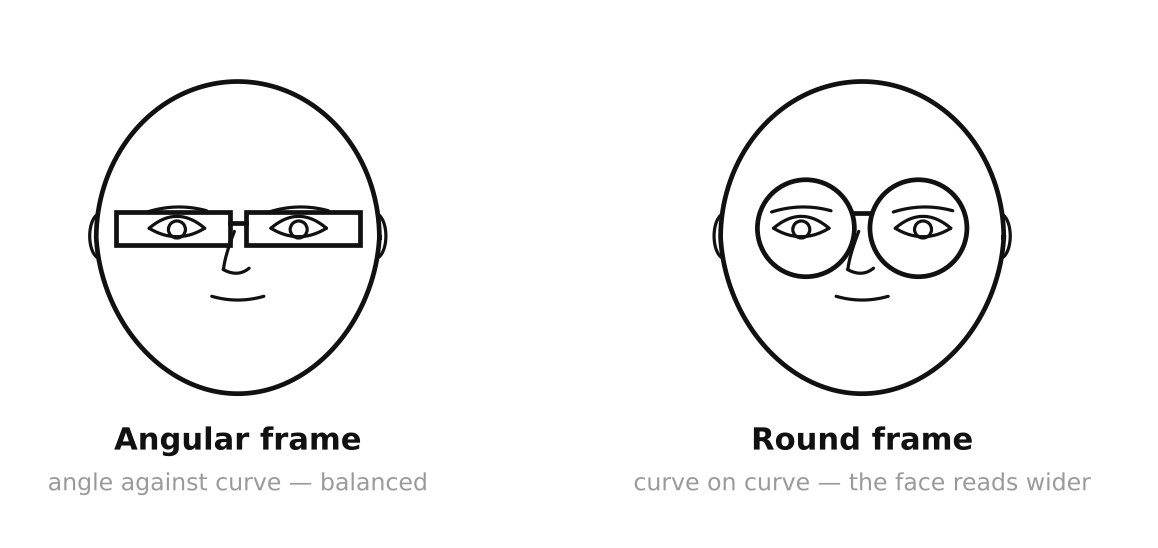
That is the whole principle. Once you have it, you can judge a frame in a shop without thinking about categories at all. Straight lines and corners help. Circles do not.
Size is the one exception. A large round frame on a round face is less of a problem than a small one, because at least it is not sitting inside the width of the face. But it is still the hardest shape to make work. There is no reason to start there.
The four that work
Rectangular
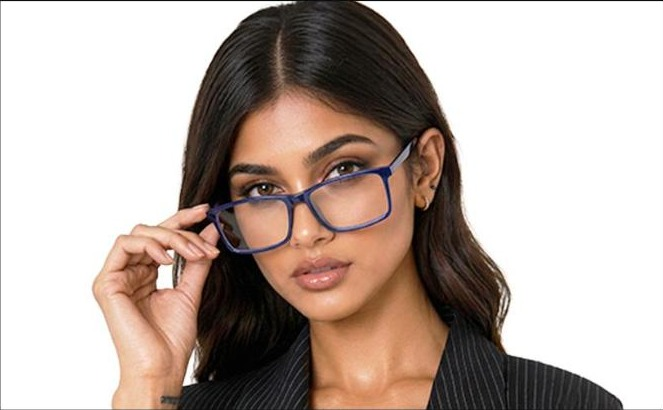
The most reliable choice and the one to try first. A rectangular frame puts two straight horizontal lines across the middle of the face. That does more to change how the face reads than anything else on this list.
Go wider rather than deeper. A rectangle that is tall from top rim to bottom starts to fill the face in and works against you.
Cat-eye
The upswept outer corners lift the eye away from the cheeks. That is exactly where a round face carries its width. It is the shape that does the most work for the least effort.
A wider cat-eye beats a narrow one here. The lift only helps if there is some width behind it.
Browline
Heavy along the top edge, light or rimless below. The dark bar runs straight across and draws a hard horizontal line where the face has none.
It also sits high, which is the second thing a round face wants.
These were a men's style for about forty years. They are not any more. Worth saying, because plenty of women still skip past them.
Angular geometric
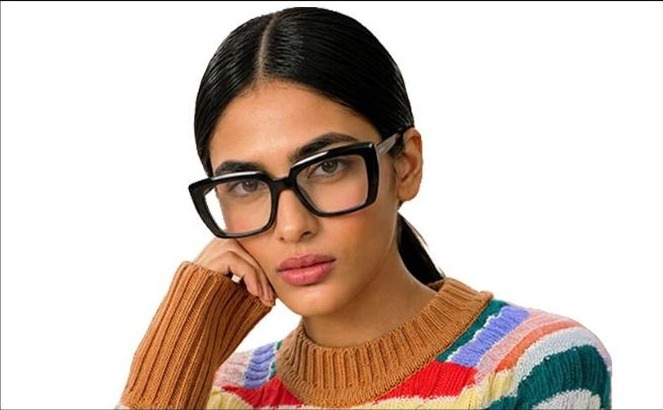
Hexagons and similar frames are the bolder end of the same idea. All corners, no curve.
They suit a round face better than almost any other face shape. That is a reasonable argument for trying a pair.
The three to skip
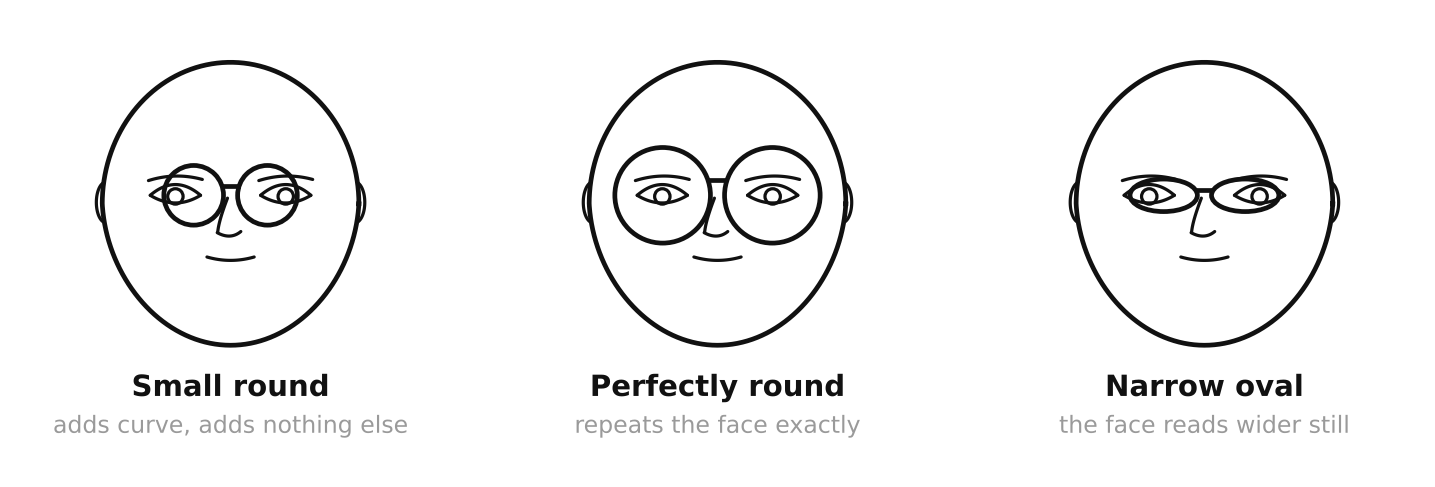
- Small round frames. They add curve and nothing else. Because they sit well inside the width of the face, the face reads wider next to them.
- Perfectly round frames. The frame repeats the outline of the face almost exactly. Some people wear this on purpose and carry it off, but it is a decision rather than an accident.
- Narrow ovals. The most common mistake, because narrow frames feel like the safe choice. Here they are the opposite of it.
None of this is a rule. If you have worn round frames for years and like them, nothing here should talk you out of it. But if a pair looks slightly wrong in the mirror and you cannot name it, it is usually one of these three.
The two things that matter more than shape
Where the frame sits
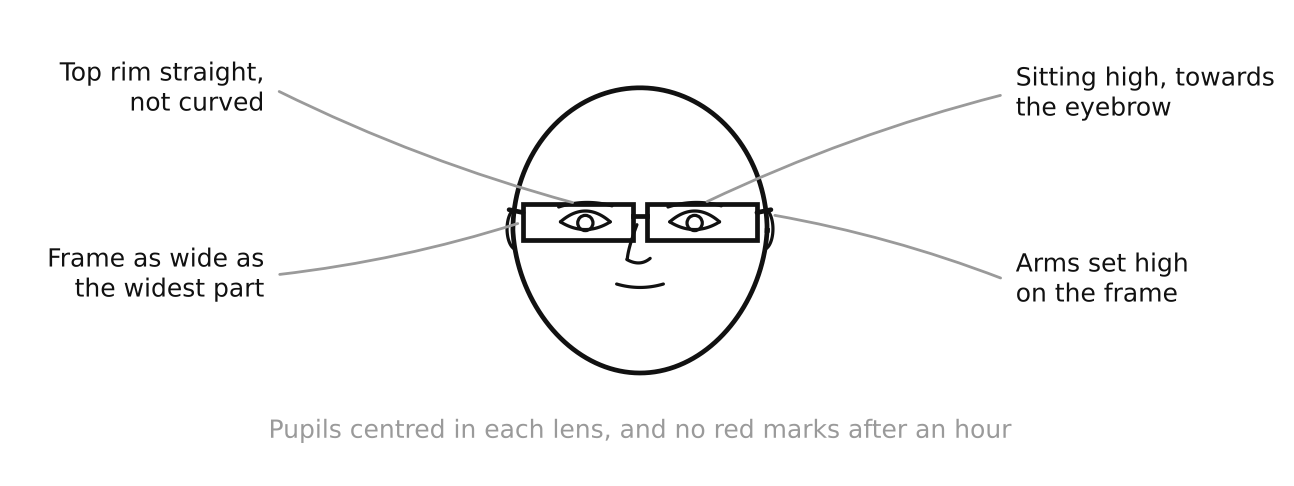
A frame that sits high, with the top rim close to the eyebrow, pulls attention up and away from the cheeks. One that sits low does the reverse.
Same frame, very different result. Almost nobody checks it.
How wide the frame is
The frame should be at least as wide as the widest part of your face. Any narrower and the face spills out either side of it.
That is the single most common reason a carefully chosen pair looks wrong.
Colour, and why it matters here
Shape gets all the attention. Colour does more than people expect on a round face.
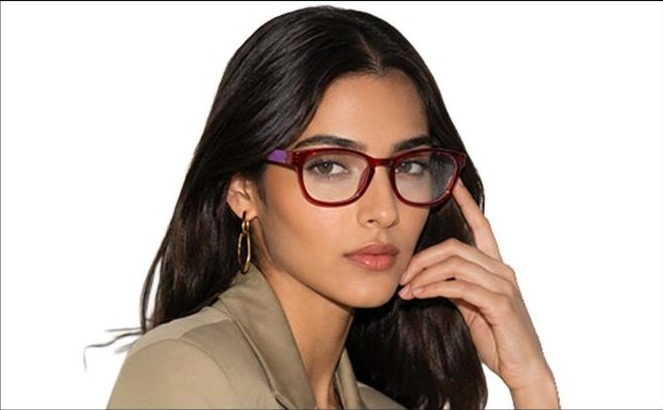
A darker frame with a visible top edge draws a firmer line across the face than a pale thin one. That is the same job the browline shape does, done with colour instead.
Tortoiseshell, deep browns and gold sit well against most Indian skin tones. Very pale and very bright frames can work, but the shape then has to do the heavy lifting, because the colour will not.
Where to get the test done
Frame shape is what everyone researches. The prescription is what decides whether the glasses get worn at all.
A prescription that is slightly out rarely announces itself as a prescription problem. It turns up as a headache by late afternoon. Or eyes that give up sooner than they used to. Or a pair that quietly stops getting picked up.
Ben Franklin has optical centres inside partner eye hospitals across India. An optometrist tests your eyes in the same building as the eye doctors, using hospital equipment. That matters for the things a quick chart reading will miss. Glaucoma gives no warning at all until sight has already gone. Diabetes can change the back of the eye before anyone has been diagnosed.
For choosing a frame, none of that matters. For the test, it does.
Frequently Asked Questions
Which glasses suit a round face?
Rectangular, cat-eye, browline and angular geometric frames. Angles contrast with a soft, wide face. Curves repeat it.
What frames should a round face avoid?
Small round frames, perfectly round frames and narrow ovals. All three add curve, or sit inside the width of the face, or both.
How do I know if I have a round face?
It is about as wide as it is long. The cheeks are the widest part, and the jawline curves rather than turning a corner. If it is clearly longer than wide, that is an oval face.
Do cat-eye glasses suit a round face?
Yes, and they are one of the best choices. The upswept corners lift attention away from the cheeks. Choose a wide cat-eye rather than a narrow one.
Should the frame be big or small for a round face?
Wide rather than small. The frame should be at least as wide as the widest part of your face. Small frames make a round face read wider.
Try three on
Put on a rectangle, a cat-eye and something round. Look at all three in the same mirror in the same light.
The difference between the first two and the third is usually obvious within a minute. That is a far quicker answer than any article can give you.
Ben Franklin stores sit inside partner eye hospitals across India. You can try frames and have your eyes tested properly in the same visit.
Optical centres inside partner eye hospitals across India. Frame fitting and a clinical eye test in one visit. Find your nearest store at benfranklin.in/store-locator
Written by the clinical team at Ben Franklin (Eyegear Optics India Private Limited), India's largest hospital-based optical chain.