
Every article about choosing glasses tells you to work out your face shape first. Then it does not tell you how.
This one does, and it takes about two minutes.
You need a mirror and either a tape measure or a photograph. A photograph is easier and more accurate, because you can look at it twice.
Then the rest of the page explains what each shape means when you are standing in front of a wall of frames.
Step one: take the photograph
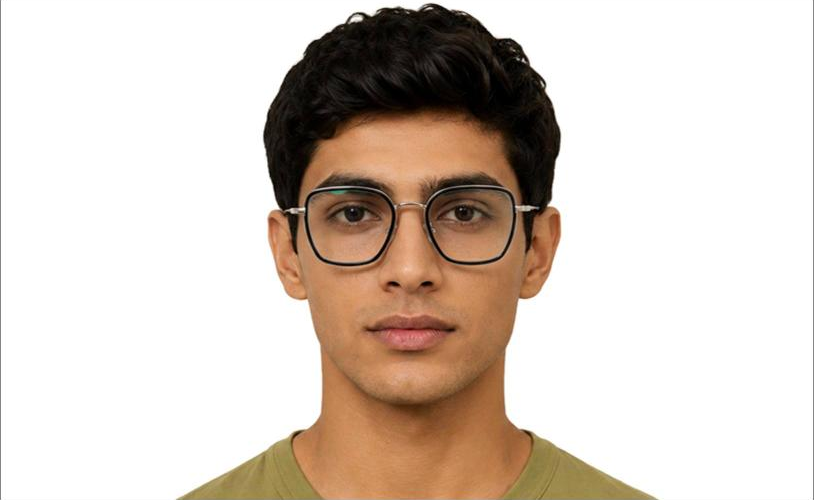
Face a window. Hold the phone at eye level, about an arm away. Pull your hair back off your face and look straight ahead.
No smiling and no tilting. Both change the shape of the jaw.
Front camera is fine. You are measuring proportions, not taking a portrait.
Step two: two measurements
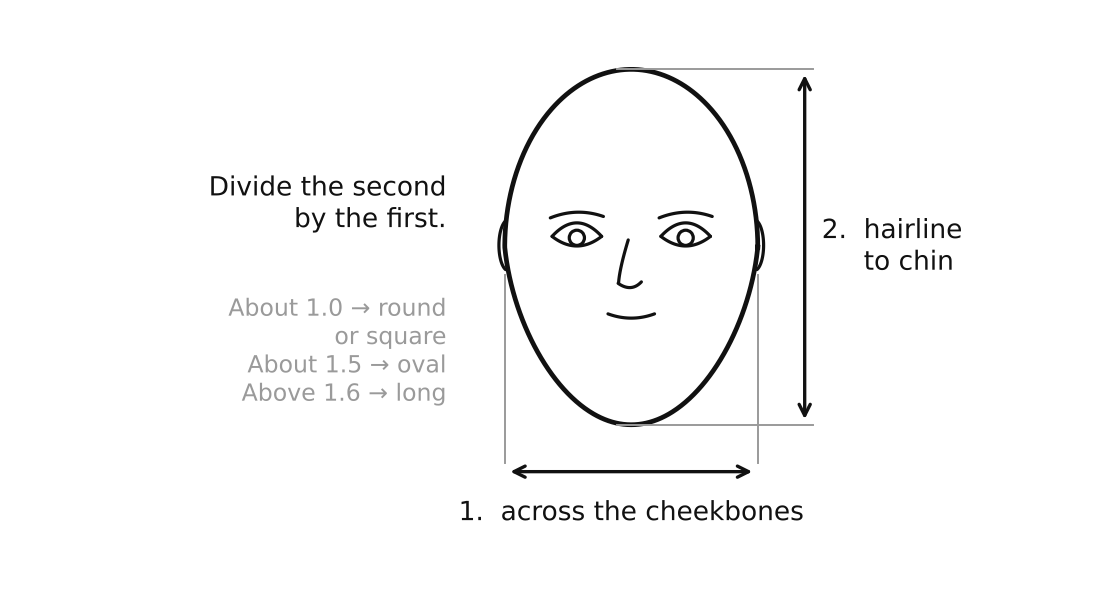
Measure the width across the widest part of your face. For nearly everyone that is the cheekbones.
Then measure the length, from your hairline straight down to the bottom of your chin.
Divide the length by the width. Around 1.0 means your face is about as wide as it is long, which puts you in round or square. Around 1.5 is oval. Above about 1.6 and you are into long.
You can do this on the photo with a ruler held up to the screen. The actual numbers do not matter at all. Only the ratio between them does.
Step three: look at your jaw
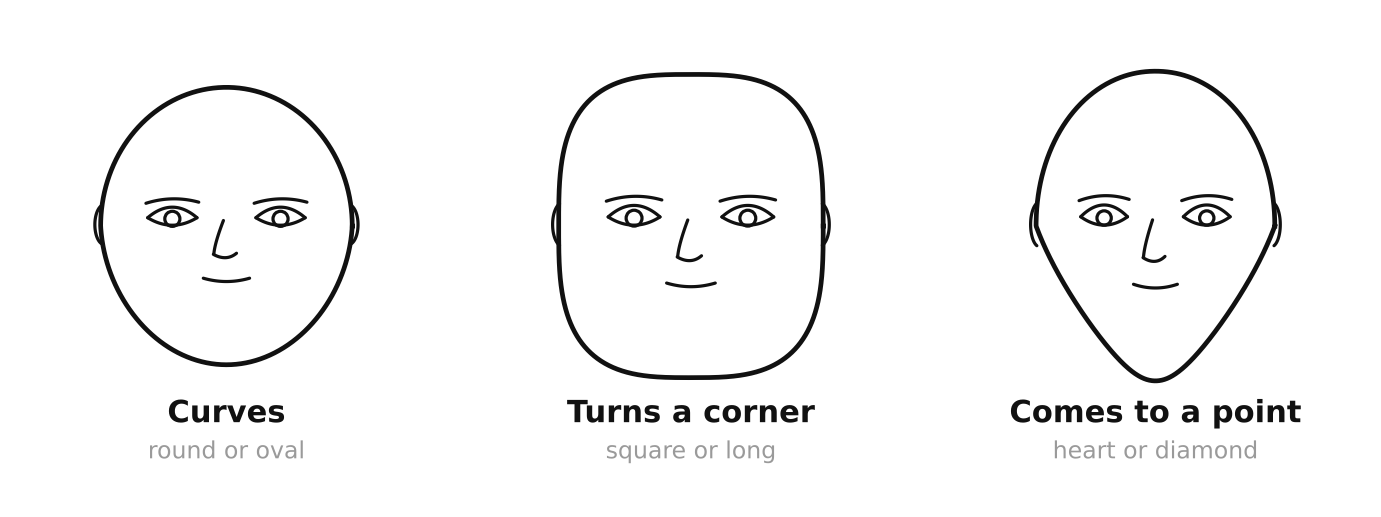
The ratio narrows it down to two or three options. The jaw tells you which one.
- If the jaw curves round with no corner anywhere, you are in round or oval territory. The ratio from step two separates them.
- If the jaw turns at a definite angle you can feel under your finger, you are square or long. Again the ratio decides.
- If the jaw narrows to a point at the chin, you are heart or diamond. The difference is the forehead. Wide for heart, narrow for diamond.
That is it. Two minutes, and you have done something most people never get round to.
The six shapes, and what each one needs
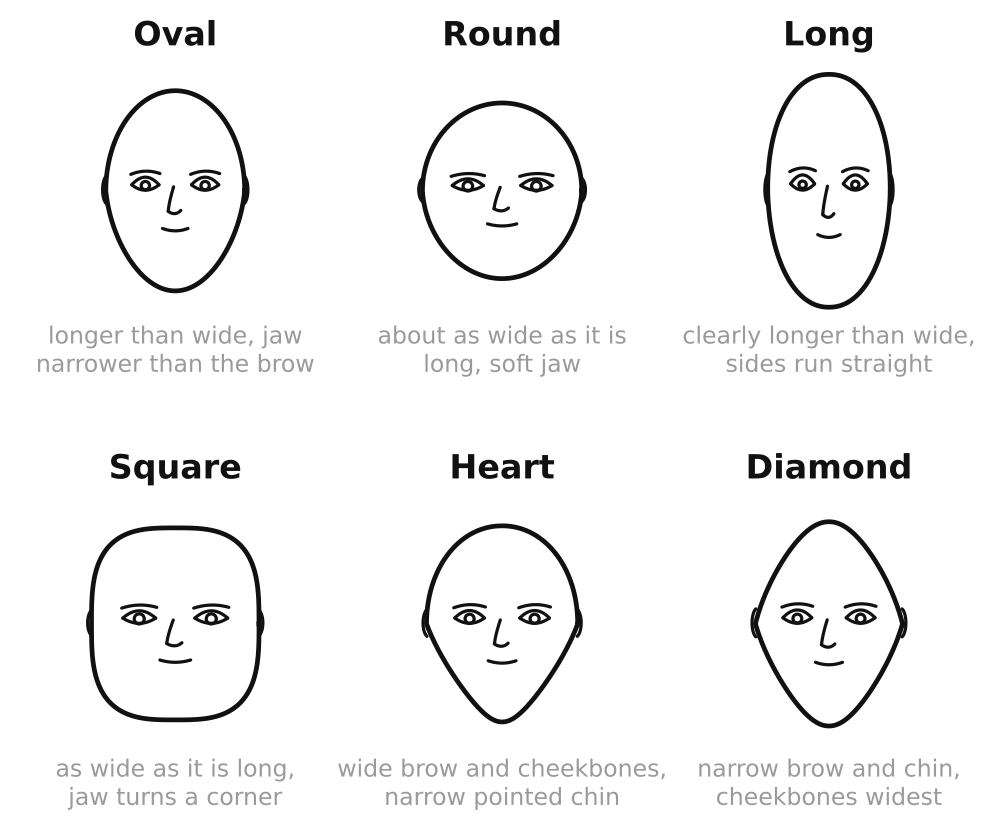
Swipe the table sideways to see every column.
| Shape | How to spot it | What frames do for it |
|---|---|---|
| Oval | About 1.5 times longer than wide, jaw narrower than the brow | Nothing needs balancing, so almost everything works |
| Round | About as wide as long, soft jaw, cheeks widest | Angles and width: rectangular, cat-eye, browline |
| Long | Clearly longer than wide, sides run straight down | Width and depth: deep frames, wide rectangles, browline |
| Square | About as wide as long, jaw turns a corner | Curve: round, oval, cat-eye, rimless |
| Heart | Wide brow and cheekbones, narrow pointed chin | Weight at the bottom: rimless, light lower rims, oval |
| Diamond | Narrow brow and chin, cheekbones clearly widest | Width at the brow: browline, cat-eye, oval |
Plenty of people land between two shapes. Go with the closer one. The frame advice overlaps more than these tables suggest, and nobody is going to check.
Read the one for your shape
Each of these covers the frames that work, the ones that don't, and what to check on the fit.
- Oval face — five frame shapes that work, and three that don't: /blogs/glasses-for-oval-face-india
- Round face — what suits it and what doesn't: /blogs/glasses-for-round-face-india
- Long face — four shapes that work, and three that don't: /blogs/glasses-for-long-face-india
- Square face — four shapes that work, and three that don't: /blogs/glasses-for-square-face-india
Heart and diamond are the two least common and we have not written those up yet. The short version for both is in the table above. It holds up well enough to shop with.
One thing worth saying about all of this
Face shape is a useful starting point. It is not a rule.
It narrows a wall of four hundred frames down to about eighty. That is the entire reason anyone bothers with it.
After that it is your face, your taste, and how the frame actually sits. Plenty of people suit something the chart says they should not. The only way to find that out is to put it on.
The measurements that genuinely are non-negotiable are the fitting ones. Frame width against your face. Your eyes centred in the lenses. Arms that reach your ears without pressing. Those decide whether you wear the glasses. Shape only decides whether you like the look of them.
Where to get the test done
While you are working out shapes, the more useful thing to book is the eye test.
Ben Franklin has optical centres inside partner eye hospitals across India. An optometrist does the test in the same building as the eye doctors, using hospital equipment rather than a chart on a wall.
That matters for what a quick reading misses. Glaucoma gives no warning until sight has gone. Diabetes can change the back of the eye before anyone has been diagnosed.
The frame is the part you will enjoy choosing. The test is the part that matters.
Frequently Asked Questions
How do I find my face shape?
Measure across your cheekbones, then from your hairline to your chin, and divide the second by the first. Around 1.0 is round or square. Around 1.5 is oval. Above 1.6 is long. Then look at your jaw: curved, cornered, or pointed.
What is the most common face shape?
Oval is the one most people land closest to. That is also why it is the easiest to fit. Round and square are the next most common.
Can I have two face shapes?
Most people are a blend. Pick whichever is closer and the frame advice still works, because the categories overlap a great deal more than the charts make out.
Does face shape really matter for glasses?
It is a useful filter rather than a rule. It narrows the choice down quickly. Fit matters more, and personal taste matters more than both.
Which face shape suits all glasses?
Oval, because nothing about it needs balancing out. Almost every frame shape works. That makes it the easiest face to shop for and the hardest to give advice about.
Then come and try some on
Two minutes with a photograph tells you where to start.
Ten minutes in front of a mirror tells you the rest, and it tells you faster than any amount of reading.
Ben Franklin stores sit inside partner eye hospitals across India. You can try frames and have your eyes tested properly in the same visit.
Optical centres inside partner eye hospitals across India. Frame fitting and a clinical eye test in one visit. Find your nearest store at benfranklin.in/store-locator
Written by the clinical team at Ben Franklin (Eyegear Optics India Private Limited), India's largest hospital-based optical chain.