
Take off your glasses and look at the inside of the left arm. Somewhere along it you will find something like 52 □ 18 – 140. Sometimes it is printed behind the bridge instead.
That is the size of the frame in millimetres. If the pair you are holding fits you, those numbers tell you what to look for next time, in any shop, online or off.
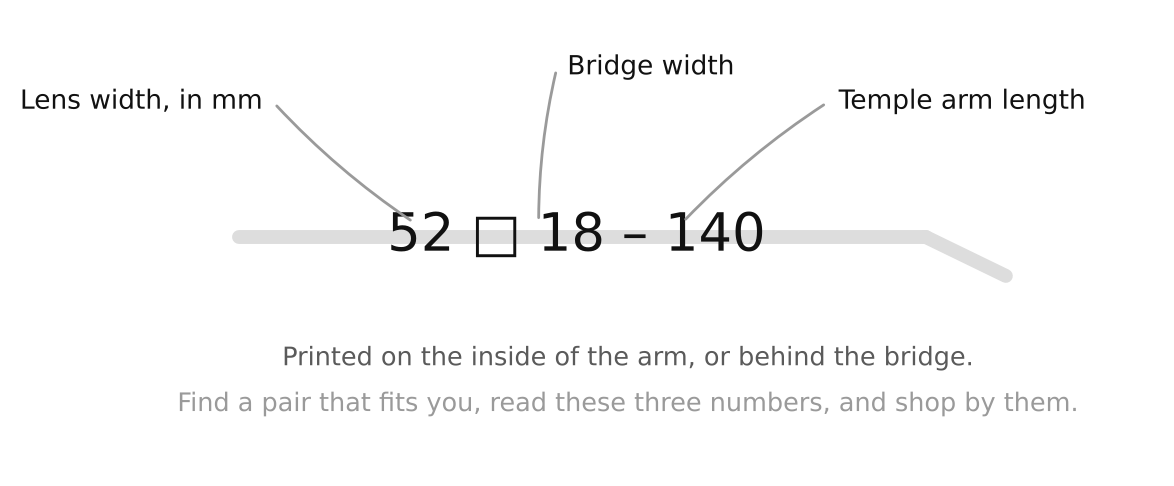
What each number does
Swipe the table sideways to see every column.
| Number | What it is | What happens if it is wrong |
|---|---|---|
| 52 | Width of one lens, in mm. Usually 40 to 62. | Too big and the frame slides. Too small and it pinches. |
| 18 | Width of the bridge, the gap between the lenses. Usually 14 to 24. | Too narrow and it sits on your nose. Too wide and it slips down. |
| 140 | Length of the arm from hinge to tip. Usually 135 to 150. | Too short and it pulls behind the ear. Too long and nothing holds it. |
Add the two lens widths and the bridge and you get roughly the width of the frame front. For 52 □ 18 that is about 122 mm plus the thickness of the rims. That total is the number that decides whether a frame fits your face.
Width is the one that matters
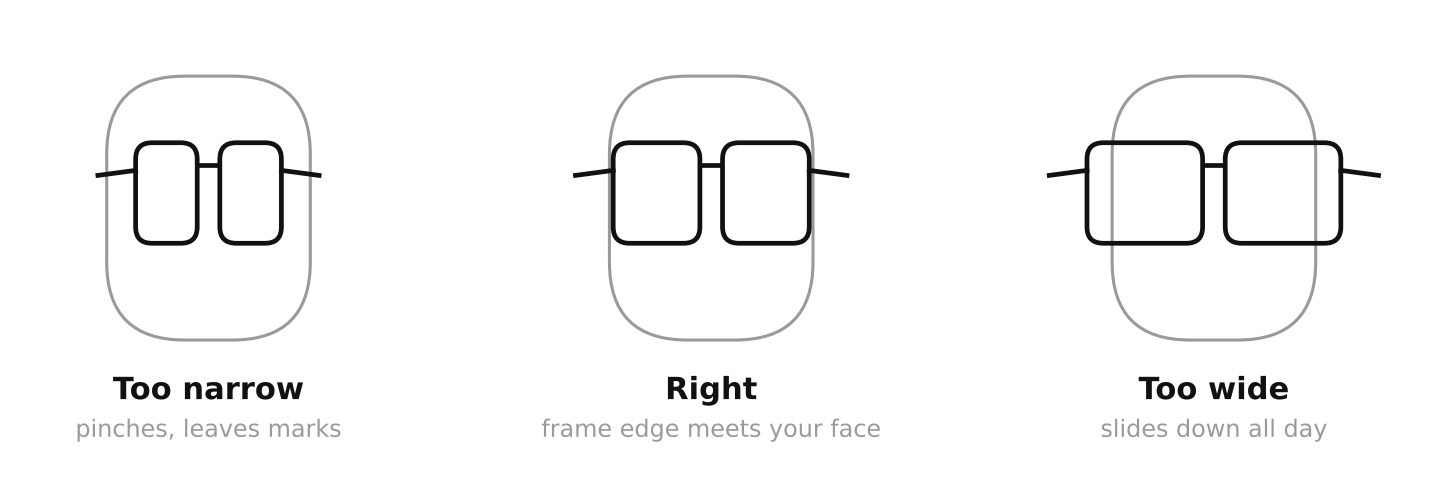
Everything else can be adjusted. Width mostly cannot.
An optician can bend the arms, move the nose pads and change the angle of the front. None of that makes a frame narrower or wider across the lenses. So if you only check one thing, check that the outer edges of the frame line up with the sides of your face.
If you have never had a pair that fits
Then there is nothing useful printed inside your current glasses, and you need a starting point instead.
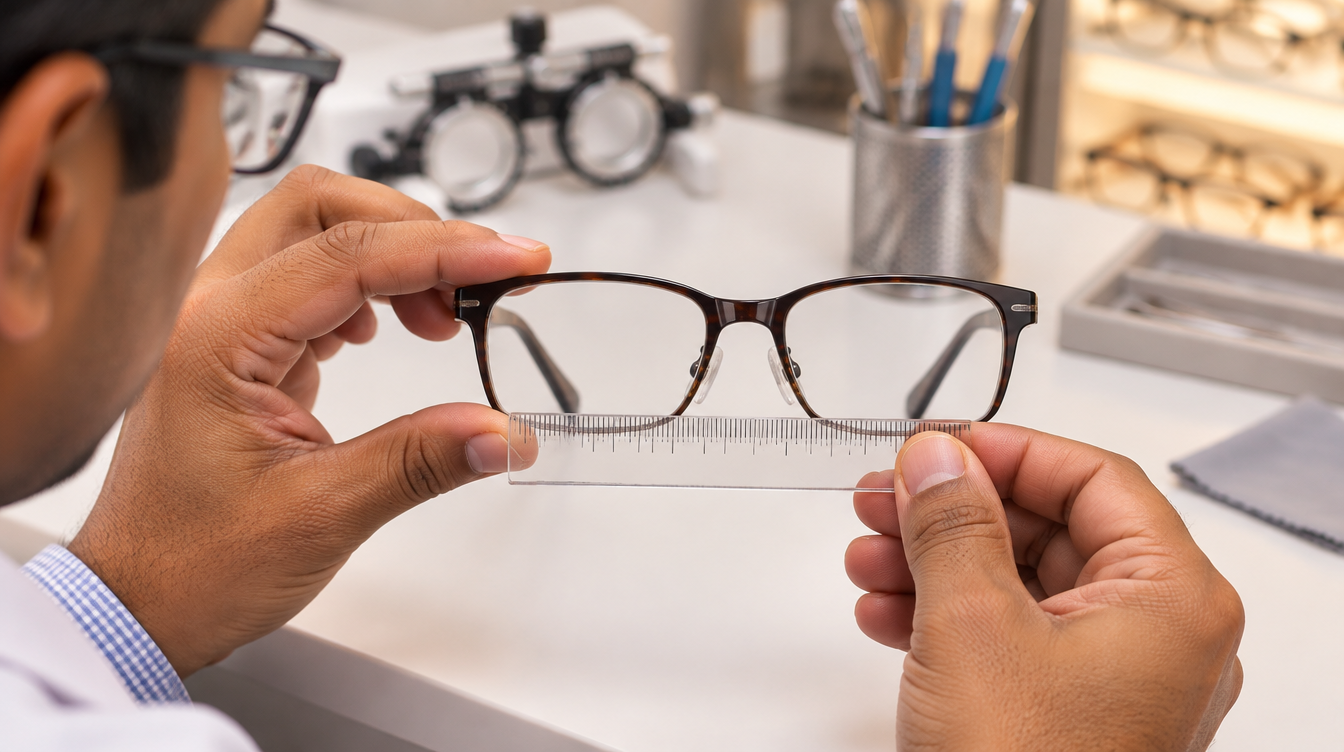
Measure the width of your face with a ruler, across the widest part, roughly level with your eyes. Most adults land between 125 and 145 mm. Look for a frame whose total front width is within about 4 mm of that. Shops list the three numbers on the label, so you can add them up as you go.
This gets you close. It does not replace trying the frame on, because two frames with the same numbers can still sit differently depending on how the arms are set.
The measurement that is not on the frame
There is a fourth number, and it is about you rather than the frame. Pupillary distance, usually written PD, is the gap between the centres of your pupils.
It decides where the optical centre of each lens is placed. Get it wrong and you are looking through the wrong part of the lens, which causes eye strain and, with a strong prescription, a pulling sensation. It matters more the stronger your prescription is, and it matters a great deal in progressive lenses.
Your PD is measured during dispensing. It is not usually written on your prescription unless you ask for it, and it is the single most common thing to go wrong when glasses are bought online.
Getting the fit adjusted
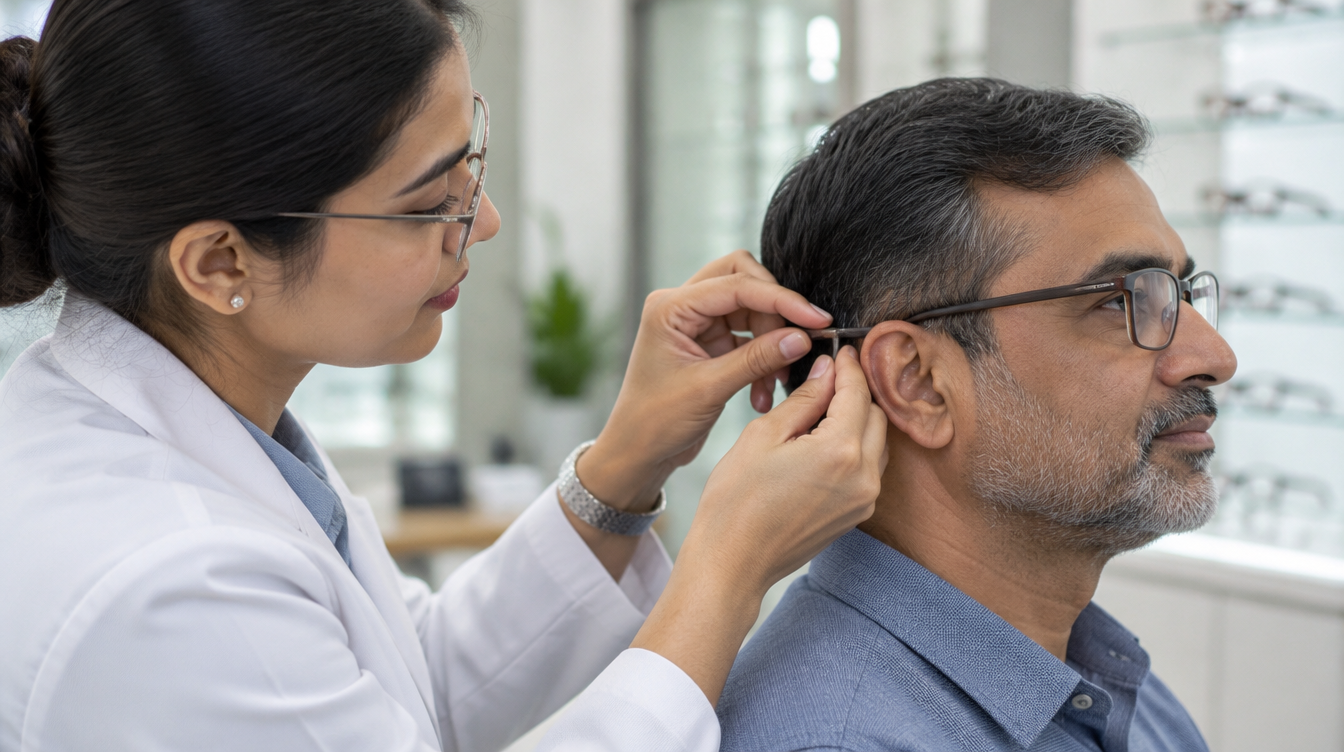
A new frame almost always needs adjusting. The arms get set to the height of your ears, the angle of the front gets tilted so the lenses sit parallel to your face, and on a metal frame the nose pads get moved.
This is free where you bought them, and it is worth going back for. People put up with glasses that slide down for months when the fix takes two minutes.
A note on children
Children's frames are not simply smaller adult frames. The bridge has to suit a nose that has not finished growing, and the arms usually need a curl behind the ear to stop the frame moving when the child does.
Fit gets checked more often too, because a frame that fitted in January may not in July. We have a separate guide to buying glasses for children.
Bring your old pair
The quickest way to get this right is to bring the glasses you already own, even if the prescription is out of date. The numbers inside the arm tell us where to start, and how they sit on your face tells us the rest.
Ben Franklin counters sit inside partner eye hospitals and clinics across India, so the eye test and the fitting happen in the same visit.
Optical centres inside partner eye hospitals across India. Frame fitting and a clinical eye test in one visit. Find your nearest store at benfranklin.in/store-locator
Written by the clinical team at Ben Franklin (Eyegear Optics India Private Limited), India's largest hospital-based optical chain.
How to choose spectacle frames