
Short answer first.
Four shapes work on a long face. Deep frames, wide rectangles, browline frames and oversized round.
Three usually don't. Small frames, narrow frames, and thin rimless.
One thing matters more than the shape. Lens depth. You want frames that are tall from the top rim to the bottom, around 38mm or more. That one number does more for a long face than the shape ever will.
The rest of this page explains why, and how to check it without a tape measure.
First, is your face actually long?
A long face is clearly longer than it is wide. The sides run more or less straight down. Your forehead, cheekbones and jaw sit at about the same width, so nothing narrows anywhere.
You will also see it called oblong or rectangular. Same face, different word.
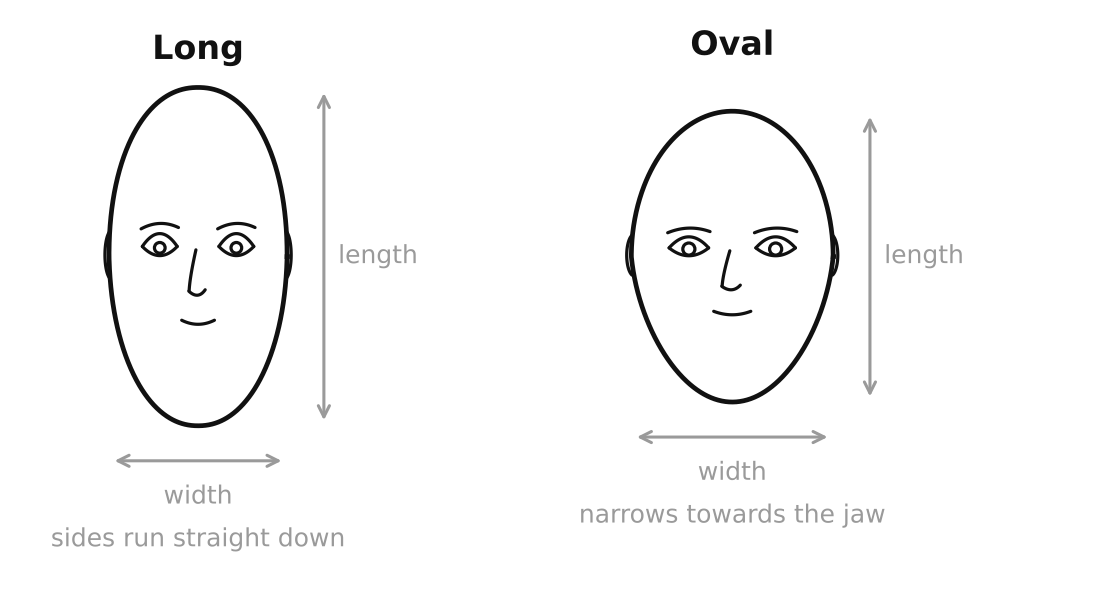
Check the jaw. Plenty of people decide they have a long face when they have an oval one. They then spend years avoiding frames that would have suited them.
Take a photo straight on. Look at where your face is widest. Then see whether it narrows towards the chin or stays the same width all the way down.
Why the advice here is the reverse of round face advice
Most frame guides say the same thing for every face shape. That is why they are not much use.
There is one idea underneath all of it, and it is contrast. A round face is wide and soft, so it wants angles and length. A long face already has plenty of length. What it wants is width, and something to break up the long run down the middle.
Once that clicks, you can work out the rest yourself.
The four that work
Deep frames
The most useful choice on this list. A tall lens covers more of the face between your eyebrow and your cheek. That shortens how long the face looks.
Look at the lens height, not the style name. Depth cuts across every style.
Wide rectangles
Width is the second lever. A rectangle that reaches the edges of your face puts a horizontal line across the middle of it. That line breaks up the length.
A narrow rectangle does nothing at all. Worth knowing before you buy one.
Browline
Heavy along the top, light or rimless below. The dark bar pulls the eye sideways instead of down. It also sits at about the right height to split the face into two parts.
These came back into fashion a few years ago. There is far more choice now than there used to be.
Oversized round
Round frames add curve to a face that does not have much. A large one adds width at the same time.
The word oversized is doing real work there. Small round frames make a long face look longer.
The one measurement that does most of the work
If you remember nothing else, remember this one.
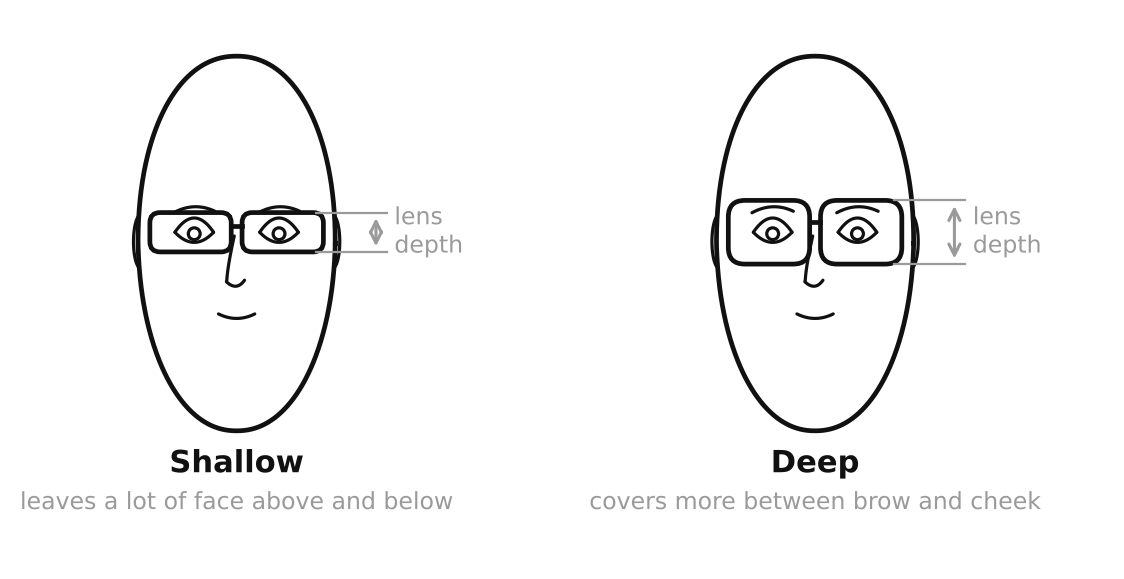
Lens depth is the distance from the top rim to the bottom rim. Most frames list it. You will find it printed on the inside of the arm, as part of a string of numbers.
Anything around 38mm or above is worth trying on a long face. Below about 32mm and you are working against yourself.
It is a boring thing to care about. It also beats worrying about whether a frame counts as rectangular or square.
The three to skip
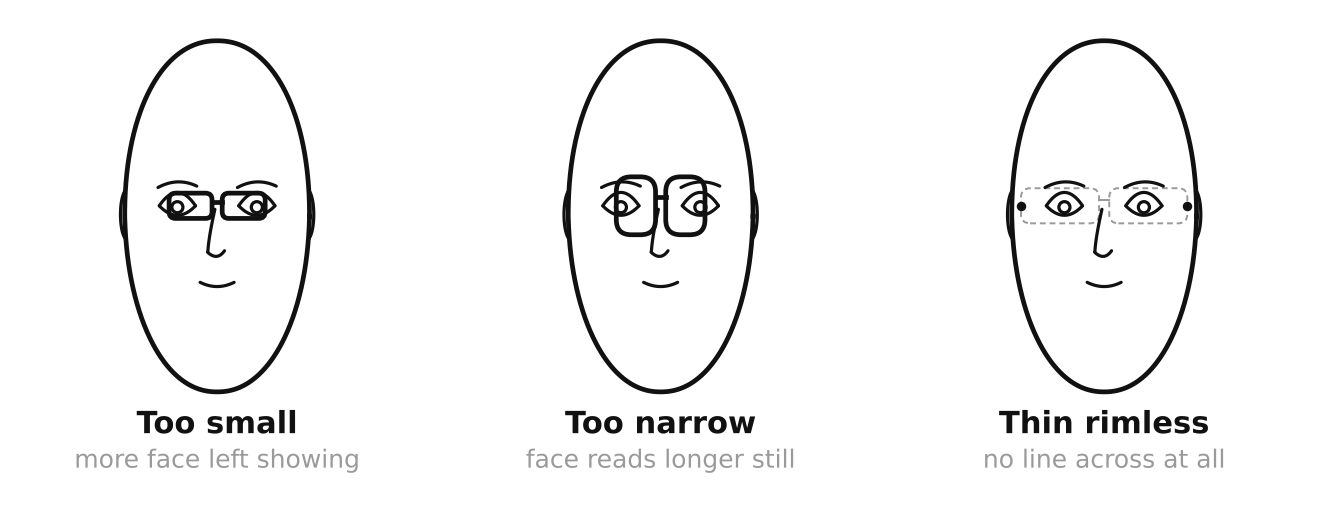
- Small frames. They leave a lot of bare face above and below. All that empty space reads as length.
- Narrow frames that sit inside the width of your face. Same problem from the other direction. People almost never catch this one in a mirror.
- Thin rimless and fine wire. There is no visible frame, so there is no line across the face at all. Nothing breaks up the run from hairline to chin.
None of these are rules. If a narrow pair looks good on you, wear them and ignore all of this. But if something feels slightly wrong about a frame and you cannot say why, it is usually one of these three.
Two small things that help more than you would expect
Wider or patterned temples
The temples are the arms that go back to your ears. A wider one adds a horizontal element at the side of your face. So does a pattern or a contrast colour.
It sounds like nothing. It works.
A low bridge
The bridge sits over your nose. Set it lower and it shortens how long the nose looks. That matters, because long faces often come with a longer nose.
A high bridge does the reverse. Ask about this in store. It almost never appears in an online product description, and any decent optician will know.
Getting the fit right
Shape is the part everyone researches. Fit decides whether the glasses end up on your face or in a drawer.
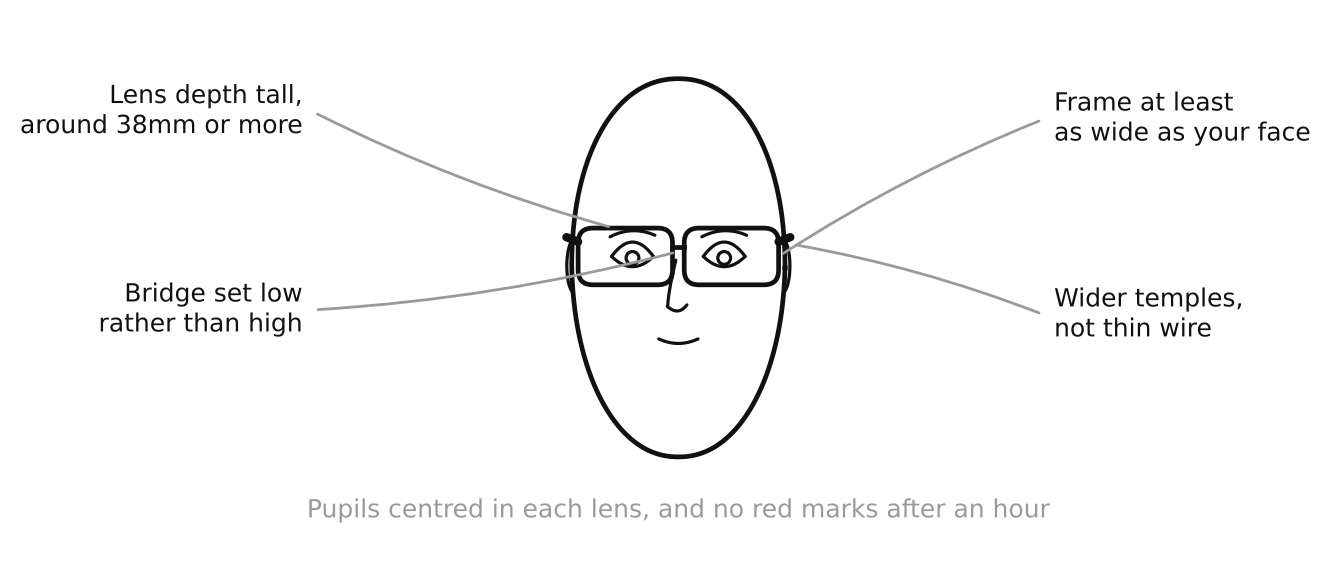
Swipe the table sideways to see every column.
| What to check | What you want with a long face |
|---|---|
| Lens depth | Tall, around 38mm or more from top rim to bottom |
| Frame width | At least as wide as your face, never narrower |
| Bridge | Set low rather than high |
| Temples | Wider or decorative rather than thin wire |
| Eye position | Your eyes centred in each lens |
| Weight | No red marks after an hour |
Getting any of these wrong will annoy you long after you stop noticing the shape. A frame that keeps sliding down gets pushed back up about forty times a day. After a couple of weeks of that, most people stop wearing it.
Where to get the test done
Frame shape is what everyone researches. The prescription is what decides whether you wear the glasses.
A prescription that is slightly out does not announce itself. It shows up as a dull ache behind the eyes by mid afternoon. Or squinting at a screen without noticing you are doing it. Or a pair you just stop picking up.
Ben Franklin has optical centres inside partner eye hospitals across India. An optometrist tests your eyes in the same building as the eye doctors, using hospital equipment. That matters for the things a quick chart reading will miss. Glaucoma gives no warning at all until sight has already gone. Diabetes can change the back of the eye before anyone has been diagnosed.
For choosing a frame, none of that matters. For the eye test it does.
If you are buying for a woman
Oversized round and large square both work. There is more choice in both than there was five years ago.
Cat-eye can work on a long face, but it has to be a wide one. A narrow cat-eye lifts the outer corners without adding any width. That is only half the job.
Colour is worth a thought. A darker frame with a visible top edge breaks up the face more than a pale thin one. Tortoiseshell and warm tones sit well against most Indian skin tones. Hold two or three up before you decide.
If you are buying for a man
Wide rectangles are the safe default and they do the job. There is no shame in stopping there.
Browline frames are the more interesting option. They suit a long face better than almost any other shape. If you have been curious about them, this is the face to try them on.
Aviators can work, but check the depth first. Some aviator styles are quite shallow, which works against you. The deeper ones are fine.
Skip thin metal rimless. It is the default choice for work glasses in half the shops in India. It is also the least helpful style for this face shape.
Frequently Asked Questions
Which glasses suit a long face?
Deep frames with tall lenses, wide rectangles, browline frames and oversized round. The aim is to add width and break up the vertical line. That is the opposite of what a round face needs.
What frames should a long face avoid?
Small frames, narrow frames and thin rimless. None of them add anything across the face, so the length is left to speak for itself.
How do I know if I have a long face?
It is clearly longer than it is wide. Your forehead, cheekbones and jaw sit at about the same width. The sides look like straight lines rather than curves. If it narrows towards the chin, that is an oval face.
Do round glasses suit a long face?
Large ones do. They add width and curve where there is neither. Small round frames make the face look longer.
What lens depth should I look for?
Around 38mm or more from the top rim to the bottom. A deeper lens covers more of the face, which shortens how long it looks.
Try four on
A frame that sounds right on paper can look wrong the second it is on your face.
Put on a deep rectangle, a browline, an oversized round, and something narrow. You will see the difference in about a minute. The narrow pair is there on purpose. Seeing what does not work tells you more than trying three things that all nearly do.
Ben Franklin stores sit inside partner eye hospitals across India. The eye test and the frame fitting happen in the same visit.
Optical centres inside partner eye hospitals across India. Frame fitting and a clinical eye test in one visit. Find your nearest store at benfranklin.in/store-locator
Written by the clinical team at Ben Franklin (Eyegear Optics India Private Limited), India's largest hospital-based optical chain.